
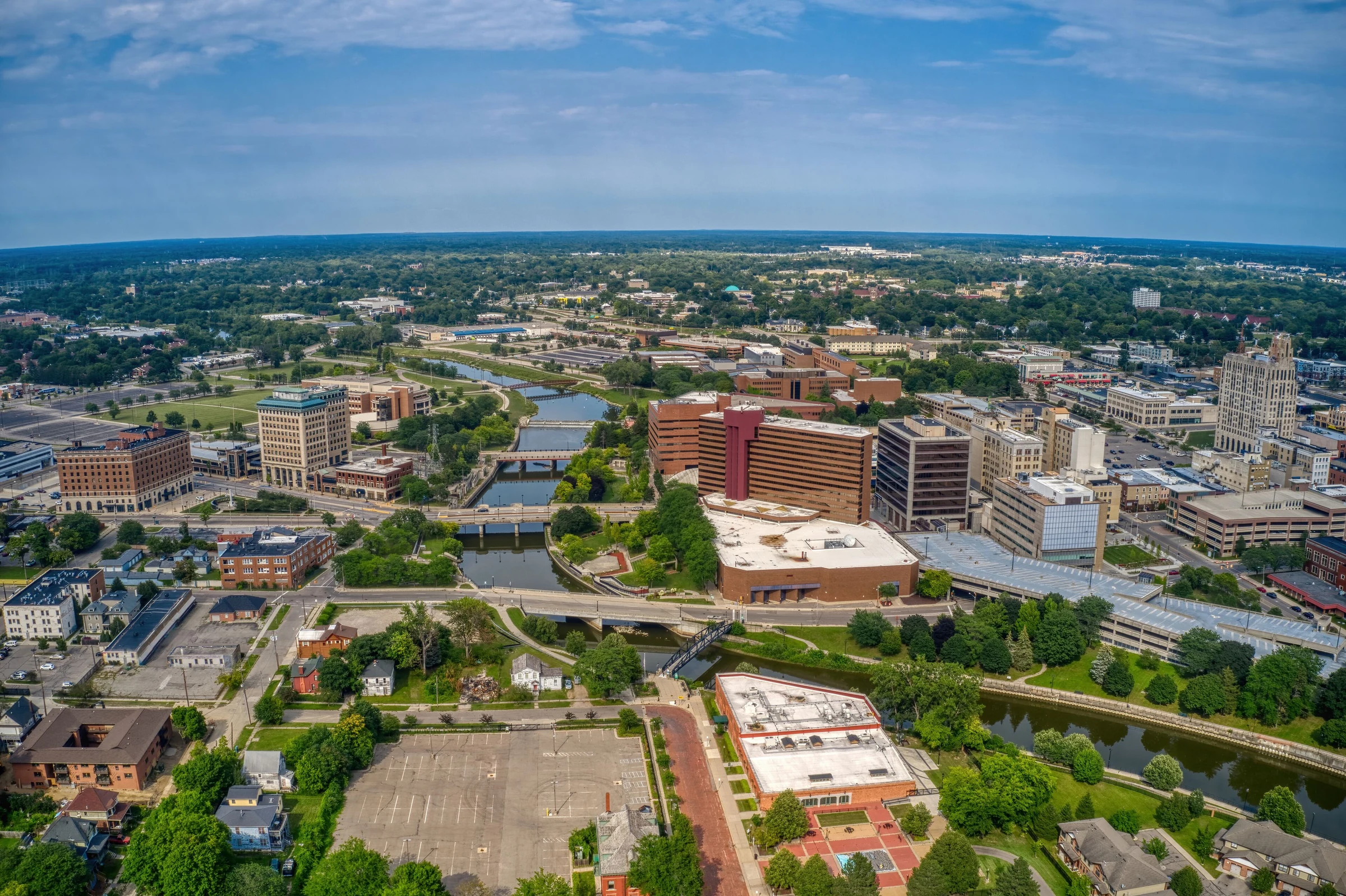
Commercial Roofing Contractors Davison, MI
Commercial Roofers in Davison
Commercial roofers serving Davison should document leak sources, wet insulation, drainage, edge details, penetrations, and repair history before recommending a scope. Davison's commercial roof stock runs small compared to the bigger footprints elsewhere in Genesee County: retail strips along M-15, a scatter of light-manufacturing shop buildings, and a compact downtown near the painted water tower that's become the town's unofficial landmark. Small doesn't mean simple, though. These roofs still fail in specific, predictable ways.
The M-15 Retail Corridor
Strip retail along M-15 runs mostly single-story buildings under a mix of older built-up roofing and newer single-ply recover, depending on when each plaza last changed hands or added a tenant. These buildings share parapet walls and roof drainage between multiple storefronts more often than a standalone building would, which means a drainage or flashing problem at one end of a strip can show up as a leak in a completely different tenant's space down the line.
Tenant mix here leans toward service retail, salons, small restaurants, and local shops rather than national chains, and that means rooftop penetrations get added piecemeal as each tenant builds out their space rather than as part of a single coordinated plan. We trace every active leak back through the roof's penetration history before assuming the nearest rooftop unit is the source, because on a shared-parapet strip, water travels sideways more than people expect.
Access is tighter on these strips than on a big-box retail lot elsewhere in the county. Parking lots behind Davison's M-15 storefronts often leave a narrow staging area for a lift or crane, and rear-of-building deliveries share the same tight space a roofing crew needs for material drops. We plan equipment staging as part of the estimate here, not as an afterthought once a crew shows up and finds nowhere to put a boom lift.
Light-Manufacturing Shop Buildings
The shop buildings scattered around Davison, small fabrication, machining, and light-assembly operations, run metal-building construction with standing seam or through-fastened metal roofing more often than membrane, which changes the maintenance conversation entirely. Fastener backout, sealant failure at lap joints, and rust at cut edges are the recurring issues on these roofs rather than membrane seam failure.
Because many of these shop buildings run a single production shift with no on-site facilities staff, roof problems often go unreported until a puddle shows up on the shop floor. We recommend an annual walk timed for early spring, after the worst of the winter's freeze-thaw cycling, so fastener backout and sealant cracking get caught before the next winter adds to it.
Because these are often owner-occupied buildings with a single tenant running the whole operation, roof decisions here tend to move faster than on a multi-tenant retail strip. There's one decision-maker, and the roof plan can move as soon as the inspection findings are in hand.
Downtown Davison and the Water Tower Landmark
The compact downtown area, visible from a distance thanks to the painted water tower, carries a handful of older commercial buildings mixed with municipal and civic structures. Roof ages vary building to building here more than anywhere else in town, since downtown redevelopment has happened in fits and starts rather than as one coordinated project.
Freeze-Thaw and Wind Exposure on Smaller Buildings
Smaller roof footprints don't escape the same freeze-thaw cycling that hits every building in Genesee County, and on a metal roof, that cycling shows up as fastener loosening and sealant cracking at panel laps rather than the membrane blistering we'd flag on a bigger flat roof. Wind exposure on a standalone shop building without neighboring structures to break the wind can also be higher than owners expect, especially on buildings near the open stretches outside the M-15 corridor's denser section.
A typical Davison roof inspection covers:
- Shared parapet and drainage tracing across multi-tenant retail strips
- Fastener and sealant condition on metal shop-building roofs
- Rust and corrosion at cut edges and panel laps
- Rooftop penetration history from tenant-by-tenant buildouts
- Wind exposure assessment for standalone buildings
- Roof age and condition mapping on mixed-era downtown buildings
- Storm damage documentation by building and roof section
Repair Realities for Owner-Occupied Shop Buildings
An owner-occupied shop building rarely needs the phased, multi-stakeholder approach a retail strip or hospital campus requires. Repairs here can usually move as soon as we've got findings in hand and the owner has a workable window in the production schedule, which is often faster to arrange on a single-tenant building than anywhere else we work in the county.
Questions Davison Owners Ask Us
Why is my shop leaking at a panel seam instead of in the middle of the roof?
Metal roofs typically fail at fastener penetrations and lap joints before the panel field itself gives out. We check those points first on every metal roof inspection.
A tenant three doors down at my strip has a leak, but so do I. Are they related?
Possibly. Shared parapets and drainage on a multi-tenant strip can carry water sideways from one unit's roof section to another's ceiling. We trace the path before assuming the nearest equipment is the source.
Does a small shop building need the same inspection as a bigger commercial roof?
Yes, the checklist is the same, just scaled to the building. Fastener, sealant, and edge condition matter as much on a small metal roof as membrane condition does on a big flat one.
How often should a metal shop roof be inspected?
Annually at minimum, with an added check after any significant wind or hail event, since fastener backout and sealant cracking are easy to miss until a leak actually shows up.
Can repair work happen without disrupting my shop's production schedule?
Usually, yes. Single-tenant buildings give us more scheduling flexibility than a multi-tenant strip, and most repair work can be staged around your operating hours.
Related
Ready to review the roof scope?
Let’s Talk About Your Commercial Roof
Share the building, roof history, known leaks or damage, access constraints, and schedule. We’ll start with the roof condition and the facility below it.